
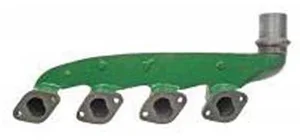
Description
There’s nothing worse than that telltale ticking sound that gets faster with engine RPM, or catching a whiff of exhaust fumes in your cab. When your manifold starts cracking or warping, you’ll hear that telltale ticking that speeds up with engine RPM, see black soot around manifold joints, or smell exhaust in the cab. A leaking manifold doesn’t just waste fuel – it can damage turbochargers and upset the precise air-fuel ratios modern engines need. This replacement exhaust manifold assembly gets your vertical exhaust system sealed up tight and running clean again.
What You’re Getting
- Complete manifold assembly designed specifically for 4-cylinder diesel engines
- Vertical exhaust design routes fumes safely away from the operator area
- Cast construction built to handle the constant heating and cooling cycles of farm work
- Direct replacement for original John Deere manifolds—no modifications needed
- Proper port spacing ensures optimal exhaust flow and performance
Built for Real Farm Work
This manifold assembly fits a wide range of John Deere compact and utility tractors from the 2000 series up through mid-size machines, plus windrowers, industrial equipment, and loader backhoes. Whether you’re running a 2020 for daily chores, using a 2630 for serious fieldwork, or operating a windrower through long harvest days, this manifold keeps exhaust gases flowing where they should. These machines see everything from light loader work to heavy field operations, and the exhaust system takes abuse with every power stroke.
Made to Last
Farm equipment exhaust manifolds face extreme conditions—the exhaust manifold channels extreme temperatures and pressures, taking abuse with every power stroke. This early-type manifold features robust cast iron construction designed to handle extreme thermal cycling. The casting is engineered to resist cracking from repeated heating and cooling cycles that destroy inferior manifolds. The material composition stands up to the temperature swings and vibration that come with real farm work.
Installation Notes
Exhaust manifold replacement is best done with a cool engine to avoid burns and seized fasteners. Start by soaking all exhaust studs with penetrating oil well before the job – these are notorious for breaking. Take your time cleaning the mating surfaces thoroughly—any old gasket material left behind will cause leaks with the new manifold. Use new gaskets and follow proper torque specifications in sequence from center outward for even pressure distribution.
Reviews
There are no reviews yet.